The Original Austin Healey Parts Specialist
OFF
VAT
>
>

Greece, 40°C Heat and a 1953 Healey 100/4

Graham Foster's two-tone Austin Healey 100/4 parked beside the sea in Greece

From workshop floor to Greek shoreline: a 1953 Healey that had to learn how to stay cool

Restoration by Graham Foster

Restoration Summary

Project overview and specifications for Graham Foster's 1953 Austin Healey 100/4
Owner Graham Foster
Car 1953 Austin Healey 100/4
Car Name NUE
Project Focus Cooling system development, engine work and heat management for driving in Greece
Key Work Completed Engine rebuild, alloy radiator, uprated water pump, 12-inch pusher fan, 82-degree thermostat, five-blade Texas Cooler fan, enlarged heat shields, bilge blower ducting and louvred bonnet
Driving Conditions Greek heat, including 40°C driving conditions
Current Result Runs around 120°F, never overheats and copes with the high temperatures in Greece

Parked by the water in Greece, Graham Foster’s 1953 Austin Healey 100/4 looks completely at ease. The setting suggests an easy life. The reality behind NUE is very different.

This is a car that has been worked on, rebuilt, experimented with and pushed to cope with very different conditions. Before it became a calm presence by the shoreline, it spent years teaching its owner exactly what it needed to cope with heat, traffic and long-distance use.

NUE was not kept away from proper use, either. Graham and NUE entered the Austin Healey Club race series in 1989, adding another chapter to a life that has included road use, mechanical setbacks, rebuilds, experimentation and Greek heat.
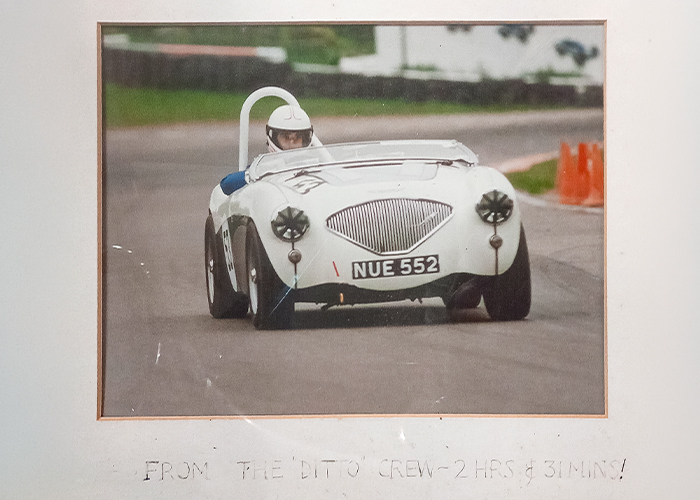
Framed photograph of Graham Foster racing NUE 552, inscribed from the Ditto crew after DTW was stripped for repair
A thank you from Bill Clegg and the “Ditto” crew after DTW was stripped for repair in 2 hours and 31 minutes.

That racing season also connects NUE’s story with Graham’s dear friend, Bill Clegg. Although Bill had a Frogeye, he and Graham shared a great deal through the Austin Healey world.

After Bill had a major shunt and badly damaged DTW, which he called “Ditto”, Graham gathered a few Healey friends, borrowed the floor of the factory next door and stripped the car in 2 hours and 31 minutes so it could be taken away for repair. Bill broke five ribs, recovered and carried on racing.

For Graham, the incident made the risk feel very real. Racing NUE had taken courage, and the thought of badly damaging a car so precious to him was enough to put him off continuing beyond one season.

Graham and Bill also helped start the East End Arms meeting and, in Graham’s words, changed the New Forest centre completely. The meeting became a long-running Austin Healey Club gathering, saw five landlords pass through, welcomed members from abroad and sat right in the heart of the New Forest.

Bill has since passed away, but this small racing chapter says a great deal about the friendship and shared Healey life that Graham remembers so fondly.
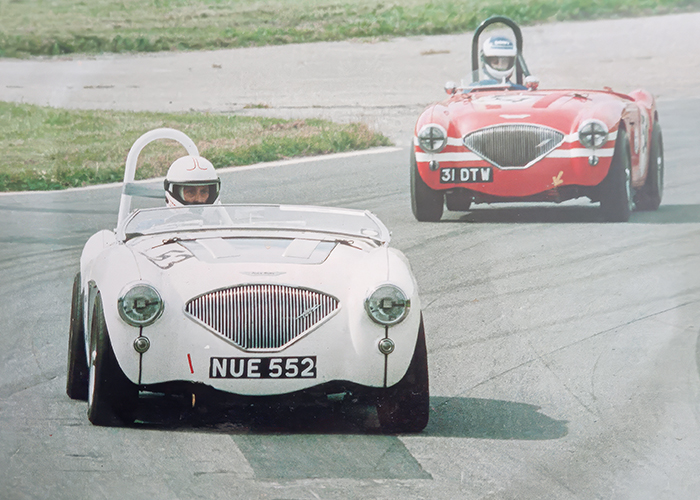
Graham Foster and NUE in the Austin Healey Club race series in 1989
Graham and NUE entered the Austin Healey Club race series in 1989.

For Graham, NUE is far more than a classic car to be admired from a distance. His words make that clear: “NUE has given me a great focus in life and continues to do so.” That single line gives this story its centre. The car has become part of his life, and the work carried out on it has been driven by use, observation and persistence.

The main thread running through Graham’s account is the cooling system. Before the car came to Greece, traffic in England could already cause the fuel to boil in the float chambers. Graham described the result plainly: bonnet-up time. Once the car was in Greece, the problem changed scale. The cooling system then had to cope with driving conditions of 40°C.

Watch NUE on film, captured by Graham’s son Bradley

Graham’s son, Bradley Foster, grew up with NUE. In Graham’s words, Bradley went from travelling in the car in a Moses basket to sitting in a child’s racing bucket seat fitted between Graham and his passenger.

Bradley made the film below early in his filmmaking journey, capturing NUE as part of the family story rather than simply as a finished classic car.

Film by Bradley Foster of Foster Media. If you would like a film made of your Healey, visit FosterMedia.de.

Graham Foster's Austin Healey 100/4 beside his sailing boat in Greece

Before Greece turned up the heat, NUE had already started fighting back

When Graham first brought NUE to Greece, the cooling system had already been modified. One of the earliest improvements was a pusher fan mounted on the X frames ahead of the radiator, helping Graham regulate temperatures more effectively in traffic and hotter conditions.

That first fan worked well. Operated by a manual switch, it gave Graham more control over how NUE coped in traffic and warmer conditions rather than simply waiting for heat to become a problem. It was an early example of the practical approach that runs through the whole story.

After the car threw a conrod en route to Le Mans in 1989, Graham built another engine. When doing so, he made sure it was very clean internally, removing piles of rusty deposits from around the waterways. This had a good effect, again helping him control the temperature when needed.

That detail says a lot about Graham’s approach to the car. Rather than simply adding more equipment, he paid close attention to the condition of the engine itself, particularly the state of the internal waterways. It reflects the practical, methodical thinking that runs throughout NUE’s development.

Then came the move to Greece, and with it a new challenge. Graham described it simply: 40°C driving temperatures. What had been useful in England now had to become much more capable.

Graham Foster's Austin Healey 100/4 in Greece

Greek heat turned cooling into the car’s defining challenge

To help NUE cope with the hotter climate, Graham fitted a Texas Cooler five-blade fan. This combination worked well, but there was still more to solve. In traffic, which Graham notes is rare on the island, the fuel would still start to boil.

His response was practical: he made a larger heat shield. That helped. The solution was not presented as a dramatic transformation, just another sensible step in a long process of learning what the car needed.

The next change was an aluminium radiator. Graham also applied thinking from another part of his life. As a sailor, he uses bilge blowers in engine bays to keep air circulating through them. He adapted that idea to the Healey.

He attached a bilge blower to the shroud support, using an air hose to take air from just behind the grille. The setup was effective, although Graham noted one drawback: bilge blowers are noisy, so the arrangement was not quite perfect.

It is a lovely piece of owner-led problem solving. Rather than treating the car in isolation, Graham drew on experience from sailing and applied it to engine bay heat management. That sort of thinking is exactly what makes long-term classic ownership so interesting. The best answers are not always found in one neat step. Sometimes they come from trying something, listening to the car, and accepting that useful ideas may still need refining.

Engine rebuild and cooling system development

Graham Foster's Austin Healey 100/4 during body and chassis restoration

In 2018, the engine came out for a full rebuild

In 2018, NUE’s engine started losing compression. Graham removed the head and found damaged rings on cylinders 2 and 4. The engine then came out and had a full rebuild.

Soon afterwards, Graham went to Australia with a good friend to buy a 100S. While there, he saw that the car had an electric water pump fitted inline from the bottom hose. It immediately looked like an idea that could be adapted for NUE.

When Graham returned home, he spoke with an English man in Greece who ran a garage. During a conversation about water pumps, the garage owner said he thought he had one of those Davies Craig pumps somewhere.

Graham removed the original water pump, which was new but leaking, made a blanking plate and fitted the Davies Craig pump. The pump was controlled by a manual switch and always ran with the engine. It gave full flow at tickover, which Graham described as a vast improvement over the 100 pump.

Graham Foster's Austin Healey 100/4 during reassembly

The electric water pump worked well, but not perfectly

For a while, Graham ran NUE with the Davies Craig pump and without a thermostat. The setup was highly effective at keeping the car cool. In fact, Graham joked that NUE thought they had moved again, this time to Iceland.

However, the arrangement also created problems. Graham found that it seemed to pressurise the whole cooling system. Occasionally it would blow a hose off. He would refit the hose with better clamps, but then the car blew a core plug, followed by another.

At that point, Graham decided the setup had to change. He removed the Davies Craig pump and fitted a new uprated original-type water pump, along with an aluminium thermostat housing.

That sequence captures one of the most honest parts of Graham’s story. The electric pump was not a failed idea in simple terms. It gave full flow at tickover and represented a major improvement in that respect. But it also introduced other issues, and those issues eventually outweighed its advantages.

This is often how long-term classic car development works. A change can solve one problem while exposing another. Graham did not present the process as a straight line from problem to perfect solution. Instead, it was a matter of testing, adjusting and changing course when the car made it clear that something was not quite right.

Graham Foster's Austin Healey 100/4 during reassembly after restoration work

NUE now runs cool in the heat of Greece

Today, NUE runs with a carefully developed cooling and heat management setup. It is the result of many stages of experimentation, from early fan improvements and cleaner waterways to the aluminium radiator, heat shields and later water pump changes.

Graham’s current arrangement includes an alloy radiator, alloy head, uprated water pump, 12-inch pusher fan, 82-degree thermostat and five-blade Texas Cooler fan. The heater remains in place, and the car also runs with an LCB, which Graham says helps engine bay heat dissipation.

There are enlarged heat shields, a bilge blower fan with ducting to the carburettors, and a louvred bonnet. Together, these details form a complete approach to managing coolant temperature, air movement and engine bay heat.

Current Cooling and Heat Management Setup

Current cooling and heat management specification for Graham Foster's Austin Healey 100/4
Radiator Alloy radiator
Cylinder Head Alloy head
Water Pump Uprated water pump
Electric Fan 12-inch pusher fan
Thermostat 82-degree thermostat
Engine Fan Five-blade Texas Cooler fan
Heat Management Heater in place, LCB, enlarged heat shields, bilge blower fan with ducting to the carburettors and louvred bonnet

Not restored for show. Refined because Greece demanded it.

Graham Foster’s story is a reminder that restoration and long-term ownership do not always follow a neat, single path. NUE has been adapted through use, setbacks and observation. A thrown conrod led to another engine. Later compression loss led to a full rebuild. Greek heat pushed the cooling system far beyond what had already been needed in England.

Along the way, Graham tried a pusher fan, cleaned the internal waterways, fitted a Texas Cooler fan, made a larger heat shield, added an aluminium radiator, adapted a bilge blower arrangement, experimented with a Davies Craig electric water pump, and then returned to an uprated original-type water pump when the electric setup caused pressure-related problems.

Graham Foster's 1953 Austin Healey 100/4 during cooling system work
Graham Foster's Austin Healey 100/4 body and chassis during restoration

The result is not just a list of parts. It is a car that has been developed thoughtfully around the conditions it faces. Graham’s account shows the value of paying attention to what a car is telling you, especially when it is being used in demanding temperatures.

There is also something deeply personal running through the story. NUE is not presented as a finished object tucked away from life. She is a car that continues to matter to Graham. She has been changed, repaired, tested and improved, but always with the same purpose: to keep her usable, dependable and part of his life.

That is what gives this Austin Healey 100/4 restoration story its character. It is not about chasing perfection for its own sake. It is about solving real problems, adapting old engineering to a hotter climate, and keeping a much-loved car where it belongs: on the road.

Graham Foster's Austin Healey 100/4 during restoration work
Graham Foster's Austin Healey 100/4 finished after restoration work

Share your own Austin Healey restoration story

Have you restored, rebuilt, rescued or steadily improved your Austin Healey? Whether your story involves a full rebuild, a long-running project or years of careful improvements, we would love to hear about it.

Share your story with us


British Motor Heritage logo range

Gallery Images

Click on an image for a larger view.

Comments

  • There are no comments for this page - be the first to add your thoughts...

Leave a Comment

* Denotes Required Field

So that we can check that you are a real person (and not a crafty computer), answer this simple sum:

Human Validation Check

What is 17 - 5?
  
Top